
Home » Helicopter Firefighting Bucket Buyer’s Guide: Choosing Bucket Size by Aircraft
Helicopter Firefighting Bucket Buyer's Guide: Choosing Bucket Size by Aircraft
Helicopter firefighting water buckets range from roughly 260 US gallons (1,000 L) on Type 3 light helicopters up to 2,600 US gallons (9,800 L) on Type 1 heavy-lift tandem-rotor airframes. Choosing the right capacity means balancing fresh-water payload (8.34 lb per US gallon / 1.0 kg per liter), bucket and pump tare weight, local density altitude, outside air temperature (OAT), and fuel reserve so pilots fly efficient turnaround cycles without bumping torque or gross-weight limits.
This buyer’s guide walks fleet directors, chief pilots, and procurement officers through airframe-by-airframe sizing across North American and European firefighting helicopters, including the Airbus H125 (Eurocopter AS350), Bell 205/212/412, Kaman K-1200 (K-MAX), Eurocopter AS332 Super Puma (Airbus H215), UH-60 / S-70 Black Hawk, Sikorsky S-61, and Boeing CH-47D Chinook.
How Much Water Does a Helicopter Bucket Hold? Sizing Matrix by Aircraft
Under US interagency standards (Type 3 light, Type 2 medium, Type 1 heavy) and European EASA fire contracts, external-load payload limits vary widely with elevation and OAT. Fresh water weighs roughly 8.34 lb per US gallon (1.0 kg per liter) before counting bucket tare weight, long-line rigging, and an optional bottom-fill pump. The reference overview below maps general rotorcraft classes to Kawak’s nine-model Cascade Helicopter Firefighting Bucket lineup (260 to 2,600 US gallons / 1,000 to 9,800 L); exact model sizing and hook load weights must always be confirmed against the aircraft Rotorcraft Flight Manual (RFM) and Kawak engineering.
| Aircraft Class & Example Helicopter Platforms | Lineup Coverage & Sizing Factors |
|---|---|
| Type 3 Light Utility (e.g., Airbus H125 / Eurocopter AS350) | Cascade capacities start at 260 US gal (1,000 L; 188 lb empty / 2,356 lb gross bucket-only) and 320 US gal (1,230 L; 189 lb empty / 2,858 lb gross bucket-only). Confirm exact H125/AS350 model pairing and high-altitude payload limits with Kawak engineering or Swiss Rotor Services. |
| Type 2 Medium Utility (e.g., Bell 205 / 212 / 412 / UH-1H) | Covered by Kawak’s 320 to 350 US gal (1,230 to 1,325 L) range and adjacent models; optional 28VDC powerfill enables shallow creek and portable-tank fills. |
| External-Load Lift (e.g., Kaman K-1200 / K-MAX) | Field-operated with Cascade buckets including the 660 US gal (2,500 L; 200 lb empty / 5,704 lb gross bucket-only) configuration. |
| Type 1 Heavy Utility (e.g., Eurocopter AS332 Super Puma variants including Airbus H215, Sikorsky UH-60 / S-70 Black Hawk & S-61) | Served by heavy-class Cascade capacities (such as 900 US gal / 3,410 L and 1,060 US gal / 4,000 L; build weight sheets confirmed by Kawak engineering). Kawak’s collapsible top frame folds to fit inside a Super Puma or Black Hawk cabin between bases. |
| Type 1 Heavy Lift (e.g., Boeing CH-47D Chinook) | Served up to the 2,000 US gal (7,570 L; build weight confirmed w/ engineering) and 2,600 US gal (9,800 L; 590 lb empty / 22,274 lb gross bucket-only) Cascade models. |
Always verify exact bucket capacity, tare weight, and pump configuration against your aircraft Rotorcraft Flight Manual (RFM) external-load charts, density altitude, long-line weight, and agency contract requirements. Contact Kawak engineering or Swiss Rotor Services (Europe) for airframe-specific model verification.
Five Engineering Factors Beyond Gallon Capacity
1. Density Altitude and Partial-Load Planning
Maximum hook lift at sea level on a cool morning drops significantly at 6,500 feet and 95 degrees Fahrenheit. Operators evaluate fresh-water payload (8.34 lb/US gal), empty bucket weight, rigging, and optional powerfill pump weight strictly against the aircraft Rotorcraft Flight Manual (RFM) external-load and power-assurance charts before selecting a bucket model or mission fill level.
2. Dip-Fill vs. 16-Inch Shallow-Water Powerfill
Standard dip-fill buckets require deep lakes, reservoirs, or deep rivers where the rim can submerge cleanly. Adding an optional 28VDC or 400Hz AC bottom-fill powerfill pump (or retrofitting a KJet helicopter bucket refill pump) lets crews draw from 16 inches of water in shallow creeks, stock ponds, and portable dip tanks when deep water is miles away.
3. Adjustment-Free Electric Linear Valve vs. Cable Purse-String Valves
Sealed electric linear valves (28VDC, 10A draw, under 0.5-second actuation) eliminate mechanical purse-string cable adjustments and provide multi-drop split release as standard equipment.
4. Collapsible Cabin Transport for Long Ferry Flights
Ferrying a rigid-frame bucket externally limits cruise speed and increases fuel burn. Collapsible top-frame designs allow flight crews to stow the folded bucket inside helicopter cabins, including Black Hawk and Eurocopter AS332 Super Puma aircraft, so crews ferry at normal cruise speed.
5. Slung Bucket vs. Integrated Fixed Fire Tank
Slung firefighting buckets let one operator shift water-dropping capability across multiple utility helicopters quickly with lower acquisition cost. Dedicated fire-contract airframes flying urban-interface routes or long initial-attack transits often prefer integrated fixed systems. Compare both architectures on our Helicopter Firefighting Tank Systems hub or read how helicopter firefighting buckets work.
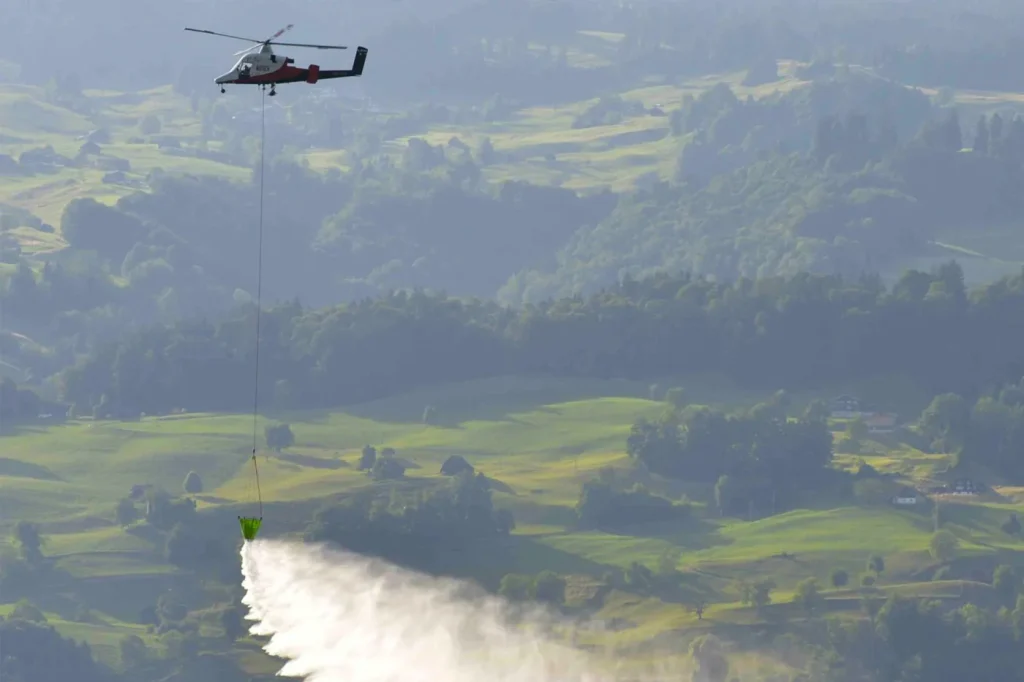
660-gallon (2,500 L) Cascade Bucket matched to Kaman K-MAX mountain external-load work.
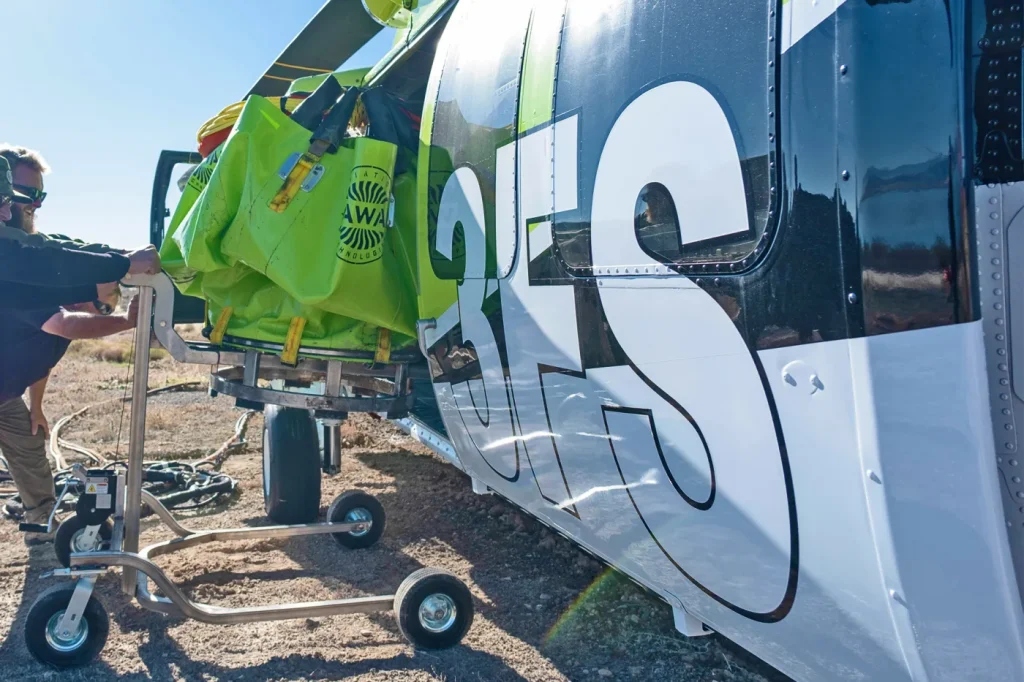
Collapsible top frame fits inside Black Hawk and Super Puma cabins for fast ferry transit.
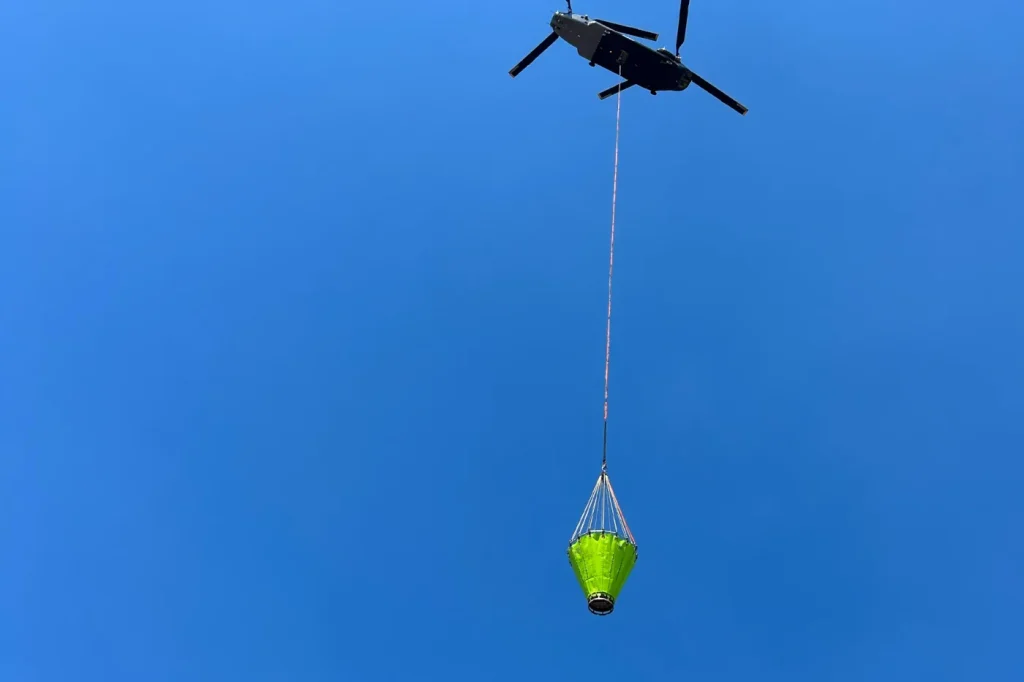
2,600-gallon (9,800 L) Cascade Bucket configured for CH-47D Chinook Type 1 heavy lift.
Helicopter Firefighting Bucket Buyer's Guide FAQs
What size firefighting bucket fits an Airbus H125 (Eurocopter AS350)?
Cascade Bucket capacities start at 260 US gallons (1,000 liters) and 320 US gallons (1,230 liters), spanning the light utility class flown by Airbus H125 / Eurocopter AS350 fleets. Exact bucket selection depends on aircraft gross-weight limits, altitude, temperature, fuel load, and optional pump hardware; always confirm your specific configuration with Kawak engineering or Swiss Rotor Services in Europe.
What firefighting bucket capacity is used on a Eurocopter AS332 Super Puma (H215)?
Kawak’s heavy-class Cascade Buckets include 900 US gallon (3,410 liter) and 1,060 US gallon (4,000 liter) models alongside adjacent capacities for Type 1 heavy utility fleets such as Eurocopter AS332 Super Puma variants (including Airbus H215). Kawak’s collapsible frame also packs inside a Super Puma cabin for ferry flights. Confirm exact variant pairing and build weights with Kawak engineering or Swiss Rotor Services.
How much does a full helicopter water bucket weigh?
Fresh water weighs approximately 8.34 lb per US gallon (1.0 kg per liter). Add the model’s verified empty bucket weight (for example, 188 lb on a 260-gal Cascade up to 590 lb on a 2,600-gal Cascade) plus optional bottom-fill pump and long-line weight. Request current Kawak engineering build weight sheets for exact gross weight planning.
Should I buy a firefighting bucket with a powerfill pump or dip-fill only?
If your operating area relies on shallow mountain creeks, small farm ponds, or portable dip tanks, a 16-inch shallow-water powerfill pump shortens turnarounds significantly. If you operate solely over deep lakes and need minimum tare weight at extreme altitude, dip-fill only saves 60 to 81 lb of hook weight.
When does a fixed helicopter fire tank make more sense than a firefighting bucket?
Fixed belly or internal tanks (such as Kawak’s CH-47D, Black Hawk, K-MAX FireMax, and Medium Bell systems) allow full VNE cruise airspeed, integrated foam systems, and zero external-load overflight restrictions, whereas buckets offer lower acquisition cost and fast cross-fleet portability.
Need help sizing a Cascade Bucket for your helicopter fleet?
Contact Kawak Aviation