
Home » How Helicopter Firefighting Buckets Work
How Helicopter Firefighting Buckets Work
A helicopter firefighting bucket hangs beneath the aircraft’s belly cargo hook on a long line, fills from a nearby water source by submerging (dip-filling) or running a bottom-mounted powerfill pump, and releases water through a cockpit-controlled bottom valve directly onto the wildfire line. Modern buckets replace manual cable-and-purse-string valves with sealed electric linear actuators that open and close in under 0.5 seconds, giving pilots full or split multi-drop control on every sortie.
This technical walkthrough explains bucket anatomy, dip-fill vs. 16-inch shallow-water powerfill mechanics, multi-drop water column physics, UHMPE rigging, and seasonal maintenance practices used by aerial firefighting crews.
Core Anatomy of a Modern Helicopter Water Bucket
Every slung firefighting bucket combines five engineered subassemblies designed to survive repeated water impacts, rotor downwash, abrasive silt, and high-tempo turnarounds:
| Component | Engineering Role | Modern Cascade Design Advantage |
|---|---|---|
| Collapsible Top Frame | Holds the bucket mouth open during dip-fill and stabilizes airflow during cruise. | Folds compactly without disassembly so crews can stow the bucket inside Black Hawk or Super Puma cabins for ferry flights. |
| Suspension Rigging & Swivel | Transfers up to 22,000+ lb of gross water load cleanly to the helicopter long line. | High-strength UHMPE synthetic lines cut tare weight and field-replace quickly with stainless steel hardware. |
| Abrasion-Resistant Shell | Contains 260 to 2,600 US gallons of water while flexing cleanly during cabin packing. | Heavy-duty industrial fabric built to handle rocky streams, portable dip tanks, and continuous flight cycles. |
| Electric Linear Multi-Drop Valve | Opens and seals the bottom dump aperture on cockpit command. | Sealed 28VDC (10A) linear actuator cycles in under 0.5 seconds with zero mechanical cable adjustments required. |
| Optional Bottom-Fill Powerfill Pump | Pumps water upward into the bucket from shallow sources without tipping the rim. | 28VDC or 400Hz AC pump draws water in 16 inches (40.6 cm) of depth, expanding usable dip sites near the fire. |
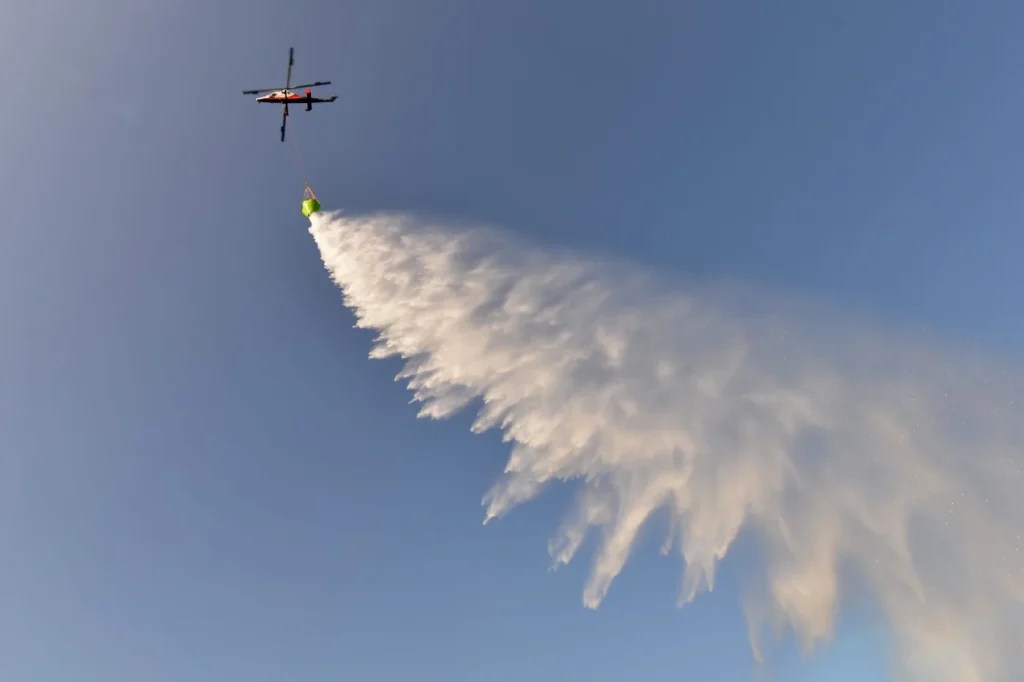
Cascade Firefighting Bucket mid-air water release demonstrating a tight, high-density drop column.
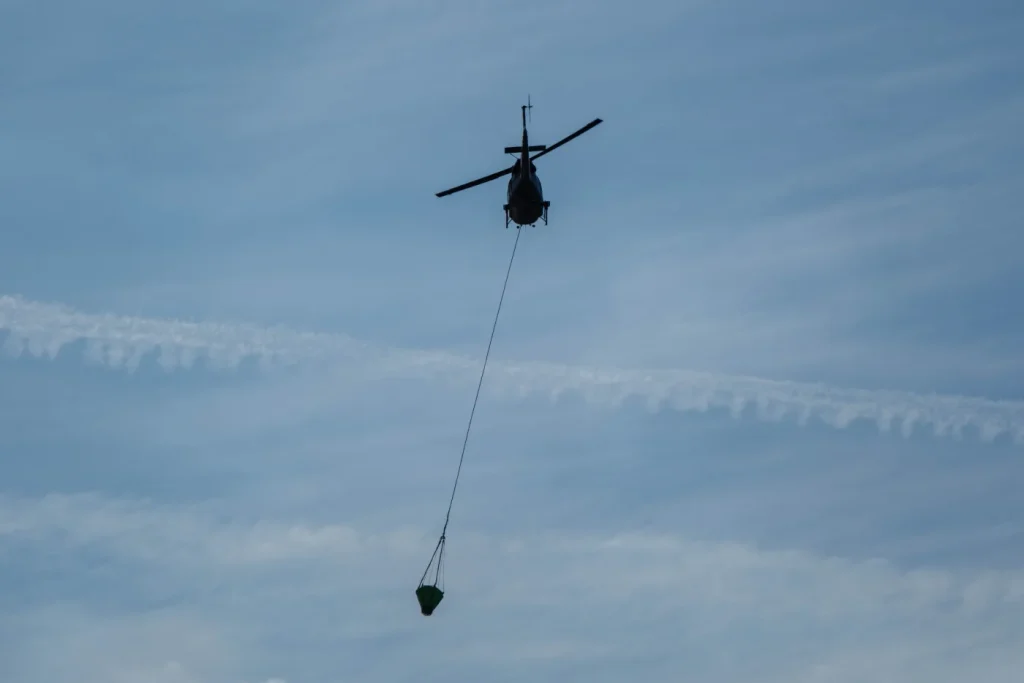
Filled Cascade bucket climbing cleanly from a dip site suspended on low-weight UHMPE synthetic rigging.
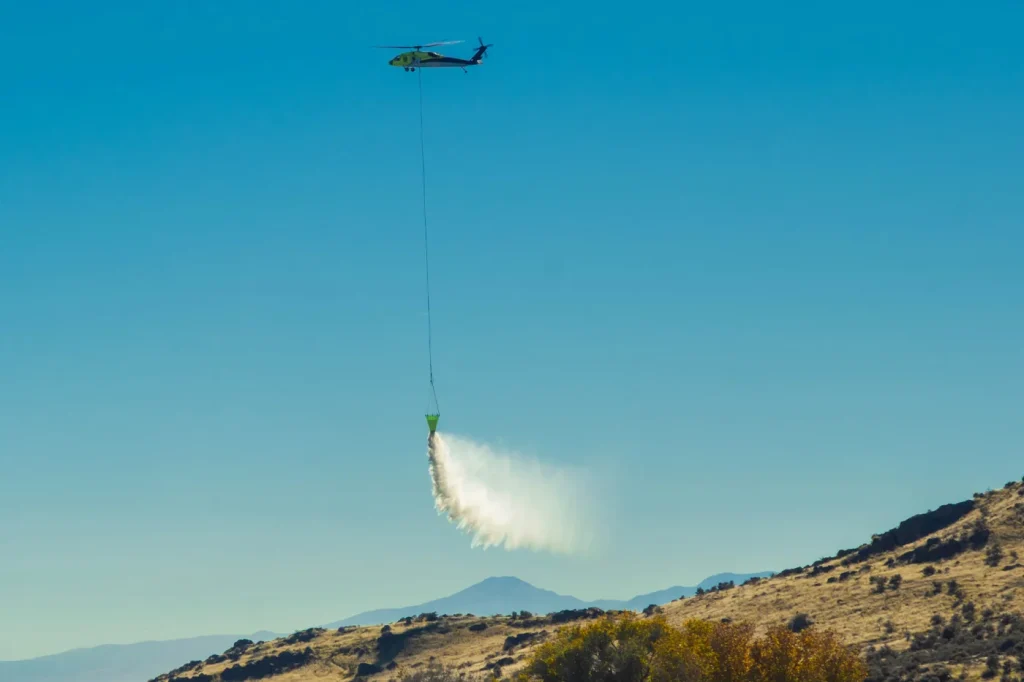
Precision high-density water column released onto a fireline from a UH-60 Black Hawk.
Dip-Fill vs. 16-Inch Shallow-Water Powerfill: Step-by-Step
General Overview: Standard Dip-Fill vs. 16-Inch Shallow-Water Powerfill
Note: The overview below describes general firefighting bucket operating concepts only. Flight crews must always follow their aircraft Rotorcraft Flight Manual (RFM), agency external-load procedures, and official Kawak Operations Manuals.
Deep-Water Dip-Fill Concept: Over deep lakes, rivers, or reservoirs, a standard dip-fill bucket tips at the water surface so water enters over the top rim, then seals cleanly at the bottom valve as the bucket lifts out.
16-Inch Shallow-Water Powerfill Concept: When deep water is far from the fireline, a bucket equipped with an optional bottom-fill 28VDC or 400Hz AC pump (or a retrofit KJet bucket refill pump) sits vertically in as little as 16 inches (40.6 cm) of water and pumps water upward through the base valve without tipping the bucket rim.
How Multi-Drop Valve Control Shapes Ground Coverage
Fire behavior determines whether crews need a concentrated water punch on a hot spot or a longer, lighter wet line across grass or brush. With a sealed electric linear valve cycling in under 0.5 seconds (10A at 28VDC), cockpit switching enables full or partial split drops on a single load without mechanical cable adjustments.
Manufacturer Documentation & Maintenance Reference
Kawak builds the Cascade Bucket for straightforward field serviceability with UHMPE synthetic rigging, stainless hardware, and a sealed electric linear actuator requiring no field rigging adjustments. Technicians should follow the official Kawak Operations & Maintenance Manual for their exact bucket model and pump kit (for example, manual KATI-IM-1194 Rev A and rebuild kit 42393-0000-RB-KIT for KJet 1600 units). Explore full specifications on our Cascade Helicopter Firefighting Bucket page or review sizing considerations in the Helicopter Firefighting Bucket Buyer’s Guide.
How Helicopter Firefighting Buckets Work: FAQs
How do helicopter pilots release water from a firefighting bucket?
A cockpit switch sends a 28VDC electrical signal down the long-line control cable to the bucket’s bottom valve actuator. On Kawak Cascade Buckets, the sealed electric linear valve opens and closes in under 0.5 seconds, allowing full dumps or multiple split drops on one fill.
How do helicopter water buckets fill up in shallow creeks or portable tanks?
Buckets equipped with bottom-fill powerfill pumps (like Kawak’s integrated Cascade powerfill option or retrofit KJet pumps) pump water straight upward through the bottom valve in as little as 16 inches (40.6 cm) of water without tipping the bucket over.
Why do modern firefighting buckets use electric linear valves instead of cable valves?
Mechanical purse-string cable valves stretch and drift out of adjustment over repeated drops. A sealed electric linear actuator eliminates field rigging adjustments, draws only 10A at 28VDC, and maintains crisp valve closure for tight water columns.
Can a helicopter bucket drop water in multiple passes instead of all at once?
Yes. Multi-drop capability lets the pilot open the electric linear valve briefly to release a fraction of the load on one spot fire, close the valve cleanly in flight, and drop the remaining water on a second target.
Ready to equip your aircraft with a Cascade Bucket or KJet Pump?
Contact Kawak Aviation